Monday, July 11, 2011

Red Cedar and Blackbutt Burl?

I'm keen to explore the possibilities of working with timber 'burl'. Burls are the tumours of the tree world. They are knobbly, knotty, bumpy, irregular tree growth. The timber found in these burls is always complex and often beautiful. On the downside they are often difficult to work (due to alternating grain and denser than normal fibers), unstable due to unpredictable changes with humidity, and fragile. 

The above pieces are dressed ~50x250x550mm in size. I'm fairly confident to resaw each into three 10-15mm panels.
 (Though I should fill the sap lines and defects with epoxy before cutting into it.)
The original burl slab.

 I have enough cedar to then frame the panels to make a small table. But it's unusual combination, will it work?


Sunday, July 10, 2011

Lectern Project: Dovetailing the Top

The dovetails for the top piece are made more complex by both the 30 degree tilt and the tapered side pieces. Some careful layout, and a good portion of the morning lead the basic carcass is complete. 


I originally planned to have a series of floating panels for the base. However, I had considerable difficulty cutting the grove due to the angles and the small dovetails. I may just have attach a smaller panel that overhangs like the top. Happy to hear peoples thoughts on this.

A clean work bench to finish the weekend.

Lectern Project: Dovetailing disappointments and other progress...

Yesterday considerable progress was made. All the pieces rough cut and dressed (by machine.) The base was dovetailed (by hand), and the center column's mitre's planned (also by hand.)
Dovetailing set up. Good times.
 

To cut the dovetails I used a different technique to normal - using measured marks with an irregular edge compared with using dovetail markers on  a square edge. The tails worked well - happy enough. The pins - below average. It's a shame, it took time and nice timber, but I think it will have to be scrapped and started again.

The lectern base (overhang will be 5mm when cut to size.)
The lectern table top ~360mm x 640mm.

The two large boards were cut from a single piece. Ripped, machined, and re-glued.


The strength and aesthetics the center column is going to be formed by splined mitre joints. This center column (whom's joinery is hidden within the larger column) was formed by hand. The mitre rough cut to 45degrees by a no 4 1/2 jack plane (which was surprising accurate) and then smoothed with a no 7 jointer (which went a little far on the inside.) The groves cut with a small plow plane. No perfect but for a first time technique it proved it can be done. 

Friday, July 8, 2011

Communion Table Design


The second piece in the church furniture project is a small communion table. A table to be situated at the front of the church and at times  hold ceremonial items like communion bread and wine while the rest of the time blend into the background.

I have some very interesting (and probably extremely difficult to work) coastal blackbutt burl which I plan to resaw into panels. The frames would be made of cedar.

Tuesday, July 5, 2011

New Cedar Boards

Last weekend I dropped in on Mal Ward from Boutique Timbers. Turned into a pleasant afternoon casually looking for 'interesting timber' and a quick cuppa.


One of the joys of woodworking is seeing the potential within the timber. This slab had been laying on the ground and was covered in mud and mould. The end had split. Most people would have walked past and missed out.


I used a jigsaw to cut down the large split end into smaller usable pieces. A no 5 and no 7 bailey did the rest. (You might also spot an interesting piece of blackbutt in the background.)


Silky smooth Australian Red Cedar. Now I just need a project.

Monday, July 4, 2011

Lectern Table

I'm in the process of fine tuning the details of the lectern design. The desk is 500x300mm - comfortable size for  2 A4 pages. It is tilted back at 30 degrees. Below is a dovetailed case reducing the angle from 30 to 15 degrees. The bottom which will show from below would be frame and panel. 


Saturday, June 18, 2011

Myrtle Anniversary Shaker Table, finished!

As a gift for my wife for our fifth wedding anniversary I’ve been slowly working on a Shaker inspired dining table. Although it needs a final wax the table has already found its way into our home. (7 months after our anniversary…)


The table is made from Tasmanian Myrtle (supplied by Boutique Timbers) with Indian Ebony accents. The top is 1m x 2m. The central boards are of 20mm fiddleback the edging 40mm of the more straight grain. The top is stabilised with a two large breadboards and two braces beneath.


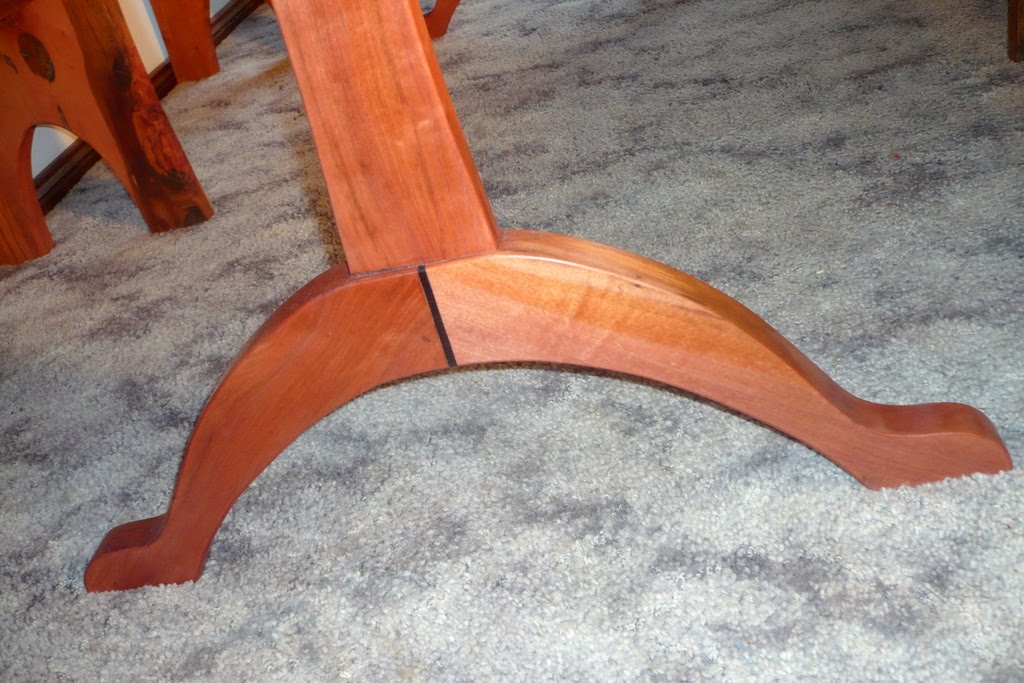
The feet are angled 40mm Myrtle joined together by a handcut sliding dovetail, and to the central post by a twin wedged tenon. The leg stretcher holds to the legs by a ebony keyed through tenon, allowing the legs to be removed and laid flat for transport.


The benches can cater for eight diners in comfort or ten on a squeeze. The 40mm timber is joined by halflap joint, screws and glue. Solid. The curved table legs allows foot room for people sitting on the ends and the central stretcher keeps well away from anyones knees. The is a single 10cm back support for the lumbar region. The sit depth is limited to 300mm (due to my planner width) which I wish her 400mm for more thigh support.


Click for details: Myrtle Anniversary Shaker Table

For more photos and detailed documentation of the work in progress check out old posts – the love of wood - Shaker Table #2: Tasmanian Mrytle.

Monday, June 13, 2011

Edge to Edge Mitres with Roy Underhill

I started thread over at Woodtalk Online about how best to strengthen the long edge to edge mitre joints that form the lectern's column. Bob Rozaieski (of Logan Cabinet Shoppe fame) pointed me to this helpful (and free) video by Roy Underhill (of The Woodwright's Shop fame). Thanks Bob.


Flat Pack Furniture

I don't have a lot of 'flat pack furniture.' Most of the time I stay clear of Ikea. But there's not reason that custom solid timber furniture can't be solid when assembled and conveniently flat when transported. 


Lectern Design


With the Shaker Table complete it's time to ponder my next few projects. After a big shop clean up and the construction/installation of the lumber rack I'll be working on some furniture projects for the local church. The first and most complex being a lectern.

The design brief: simple single column construction, adjustable in height (0.9 to 1.3m), table to hold 2 A4 pages, and two XLR panel mounts for gooseneck microphone and LED light (with cabling tunneled within). It will of course be solid timber (cedar and huon most likely), dovetailed base and top, and probably an inlayed cross.

Getting the proportions and the visual weights of the different elements I see as the  biggest challenge.


Like at Facebook

Redbubble